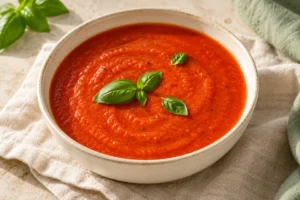
Roasted Tomato & Pepper Soup
Equipment
- Large baking tray
- Saucepan
- Immersion blender
- Knife
- Cutting board
- Wooden spoon
- Ladle
- Oven
- Kitchen scale
- Measuring jug and spoons
Ingredients
- 700 g ripe tomatoes, quartered
- 2 red bell peppers, deseeded and quartered
- 1 onion, cut into wedges
- 3 garlic cloves, peeled
- 2 tbsp olive oil
- 0.5 tsp salt
- 500 ml gluten-free vegetable broth
- 10 g fresh basil
- 0.25 tsp black pepper
Instructions
- Heat the oven to 220°C / 425°F. Spread tomatoes, peppers, onion, and garlic over a large tray. Toss with oil and salt.
- Roast for 25–30 minutes until tender and lightly browned at the edges.
- Transfer vegetables and tray juices to a saucepan. Add broth and simmer for 5 minutes.
- Take off the heat. Blend with an immersion blender until smooth, then stir in chopped basil and pepper. Adjust thickness with water and warm through if needed.
Tips and substitutions
- Use ripe tomatoes; watery ones give a milder soup.
- For a smoother finish, remove loose pepper skins after roasting.
- Bread or grilled cheese is an optional accompaniment and adds allergens.
- Ripe tomatoes give the strongest starting flavor. Very watery or under-ripe tomatoes may produce a lighter soup even when you follow the same timing. Quarter larger tomatoes consistently so no oversized piece remains firm after the other vegetables are ready.
- Spread the vegetables on a large tray rather than piling them deeply. The aim is tender vegetables with some browned edges, not an entirely blackened surface. Watch exposed garlic cloves and move them among the vegetables if they begin catching.
- Transfer the tray juices along with the vegetables. These juices carry the roasted flavor and contribute to the final texture. Use a spatula to gather them carefully without scraping burnt residue into the soup.
- Begin with the stated broth and assess thickness after blending. Tomatoes release different amounts of liquid, so the final texture may vary. Add water gradually if needed, blending or stirring before deciding whether to add more.
- If loose pepper skin bothers you, remove easily detached pieces after roasting as the original note suggests. This changes smoothness more than flavor. Use an immersion blender safely off the heat, with its head below the surface.
- Chop or tear basil for the finishing stage. A long simmer after adding it dulls its fresh aroma. Serve bread or another accompaniment separately, and include its ingredients when considering allergens rather than describing the whole meal only by the soup.
Storage and reheating
Refrigerate in a shallow, covered container within 2 hours (within 1 hour above 32°C / 90°F). Keep at 4°C / 40°F or below and use within 3 days. Reheat cooked leftovers to 74°C / 165°F, adding a splash of water if needed. Bring soup to a rolling boil when reheating.Allergens and dietary notes
Check broth for celery or other allergens Check packaged ingredients and cross-contact.Nutrition estimate per serving
One of 4 equal servings of the original recipe. Scaling the batch keeps nutrition per serving the same.
- Energy
- 128 kcal
- Protein
- 2.9 g
- Carbohydrates
- 15 g
- Fat
- 7.4 g
- Saturated fat
- 1.1 g
- Fiber
- 3.9 g
- Sugars
- 8.9 g
- Sodium
- 649 mg
Approximate ingredient-sum estimate, not a laboratory analysis. Brands, edible weights, substitutions and cooking losses change the result; use package labels when precise values matter.
Uses two 119 g red bell peppers, a 110 g onion and regular vegetable broth.
USDA FoodData Central SR Legacy (final 2018 release; published 2019-04-01)
Ingredient matches and calculation weights
USDA nutrient values per 100 g × edible ingredient grams, summed and divided by the original base yield. US spoon/volume conversions use USDA portion weights. Water and ice are excluded from the nutrient sum. An unavailable nutrient is omitted, rather than shown as zero. All listed oils, sauces and sweeteners are counted; unlisted toppings are excluded.
- 700 g ripe tomatoes, quartered: Tomatoes, red, ripe, raw, year round average (700 g)
- 2 red bell peppers, deseeded and quartered: Peppers, sweet, red, raw (238 g)
- 1 onion, cut into wedges: Onions, raw (110 g)
- 3 garlic cloves, peeled: Garlic, raw (9 g)
- 2 tbsp olive oil: Oil, olive, salad or cooking (27 g)
- 0.5 tsp salt: Salt, table (3 g)
- 500 ml gluten-free vegetable broth: Soup, vegetable broth, ready to serve (467.1 g)
- 10 g fresh basil: Basil, fresh (10 g)
- 0.25 tsp black pepper: Spices, pepper, black (0.6 g)