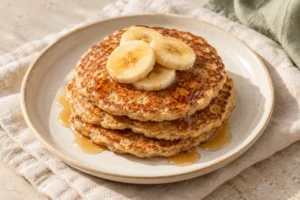
Banana Oat Pancakes
Equipment
- Mixing bowl
- Nonstick skillet
- Fork or potato masher
- Whisk
- Spatula
- Kitchen scale
- Measuring jug and spoons
Ingredients
- 1 large ripe banana, peeled
- 2 large eggs
- 90 g certified gluten-free oat flour
- 60 ml milk
- 1 tsp gluten-free baking powder
- 0.5 tsp ground cinnamon
- 0.125 tsp salt
- 2 tsp neutral oil
- 1 tbsp maple syrup, to serve
Instructions
- Mash the banana in a bowl. Whisk in the eggs and milk until combined.
- Stir in oat flour, baking powder, cinnamon, and salt. Rest for 5 minutes while the pan warms over medium-low heat.
- Lightly oil a nonstick skillet. Spoon in about 2 tablespoons of batter per pancake, leaving space between them.
- Cook for 2–3 minutes until the edges set. Flip and cook for another 2 minutes until the center is cooked through. Repeat; expect about 8 small pancakes.
- Divide between two plates and serve with the maple syrup.
Tips and substitutions
- Make small pancakes: oat batter is more delicate than wheat batter.
- If the batter becomes very thick, add 1 tablespoon of water.
- A plant drink can replace the milk, but the eggs remain. Check all labels for gluten cross-contact.
- Choose a ripe banana that mashes readily. A firm, under-ripe banana leaves larger lumps and less sweetness. Mash until the biggest pieces are gone before adding the eggs; a smoother base makes the batter easier to spread into small pancakes.
- The batter should fall from a spoon in a thick ribbon after resting. Oat flour absorbs liquid over time, so check again between batches. If it becomes difficult to portion, use the small water adjustment in the original notes rather than adding a large amount at once.
- Warm the skillet gently before the first pancake. A pan that is too cool encourages spreading and sticking; one that is too hot browns the outside before the center cooks. Use the first small pancake as a heat check and adjust before cooking the next batch.
- Wait for the edge to look set before sliding a thin spatula underneath. These pancakes are more delicate than standard wheat pancakes. Turn with a controlled movement and avoid pressing them down afterward, which can make the texture denser.
- Give the pancakes room. Crowding makes turning difficult and cools the pan when too much batter is added at once. Keep the size close to the stated two tablespoons so the cooking guidance remains relevant; a large pancake is a different timing problem.
- Serve with the listed syrup after tasting a pancake. The banana may supply enough sweetness for your preference. For storage, cool and refrigerate according to the recipe guidance, keeping layers separated so portions can be lifted without tearing.
Storage and reheating
Refrigerate in a shallow, covered container within 2 hours (within 1 hour above 32°C / 90°F). Keep at 4°C / 40°F or below and use within 3 days. Reheat cooked leftovers to 74°C / 165°F, adding a splash of water if needed.Allergens and dietary notes
Egg · Milk Check packaged ingredients and cross-contact.Nutrition estimate per serving
One of 2 equal servings of the original recipe. Scaling the batch keeps nutrition per serving the same.
- Energy
- 398 kcal
- Protein
- 14.7 g
- Carbohydrates
- 54.7 g
- Fat
- 14.2 g
- Saturated fat
- 3.1 g
- Fiber
- 5 g
- Sugars
- 16.5 g
- Sodium
- 423 mg
Approximate ingredient-sum estimate, not a laboratory analysis. Brands, edible weights, substitutions and cooking losses change the result; use package labels when precise values matter.
Uses a 136 g edible banana, 2% dairy milk, 9 g canola oil and the serving maple syrup. Oat flour and baking powder use generic USDA entries.
USDA FoodData Central SR Legacy (final 2018 release; published 2019-04-01)
Ingredient matches and calculation weights
USDA nutrient values per 100 g × edible ingredient grams, summed and divided by the original base yield. US spoon/volume conversions use USDA portion weights. Water and ice are excluded from the nutrient sum. An unavailable nutrient is omitted, rather than shown as zero. All listed oils, sauces and sweeteners are counted; unlisted toppings are excluded.
- 1 large ripe banana, peeled: Bananas, raw (136 g)
- 2 large eggs: Egg, whole, raw, fresh (100 g)
- 90 g certified gluten-free oat flour: Oat flour, partially debranned (90 g)
- 60 ml milk: Milk, reduced fat, fluid, 2% milkfat, with added vitamin A and vitamin D (61.9 g)
- 1 tsp gluten-free baking powder: Leavening agents, baking powder, double-acting, straight phosphate (4.6 g)
- 0.5 tsp ground cinnamon: Spices, cinnamon, ground (1.3 g)
- 0.125 tsp salt: Salt, table (0.8 g)
- 2 tsp neutral oil: Oil, canola (9 g)
- 1 tbsp maple syrup, to serve: Syrups, maple (20 g)