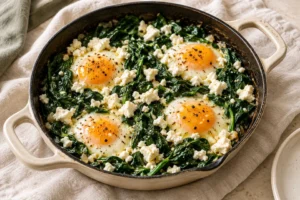
Spinach & Feta Skillet Eggs
Equipment
- Lidded skillet
- Food thermometer
- Knife
- Cutting board
- Spatula
- Kitchen scale
- Measuring jug and spoons
Ingredients
- 1 tbsp olive oil
- 1 small onion, thinly sliced
- 100 g baby spinach, washed
- 4 large eggs
- 60 g vegetarian-labelled feta, crumbled
- 0.25 tsp black pepper
- 0.125 tsp salt
Instructions
- Warm the oil in a lidded medium skillet over medium heat. Add the onion and cook for 5 minutes, stirring, until softened.
- Add the spinach and cook for 2 minutes until wilted. Season with salt and pepper.
- Make four shallow spaces in the spinach. Crack an egg into each space and scatter the feta around them.
- Cover and cook over low heat for 5 minutes, or longer as needed, until both whites and yolks are firm. An egg mixture should reach 71°C / 160°F. Serve promptly.
Tips and substitutions
- A wide skillet gives the eggs enough room to cook evenly.
- Choose feta made with vegetarian rennet for the vegetarian label to apply.
- Timing varies with egg size and pan heat; use the doneness checks in the instructions.
- Use a pan that accommodates four separate eggs. If the eggs overlap heavily, their centers and edges may cook unevenly. A lid matters here: it retains heat above the food while you keep the heat under the skillet gentle.
- Let the spinach's released moisture settle before making the wells. A shallow layer of moisture is expected, but a very wet pan can dilute the seasoning. Keep the vegetables moving briefly until they are wilted and the pan is no longer flooded.
- Make the wells shallow rather than scraping the pan completely bare. A small amount of spinach beneath each egg helps prevent sticking. Crack the eggs into small bowls first if you want to check for shell pieces before adding them.
- Feta contributes salt as well as flavor. Use the listed seasoning initially and taste a cooked portion before adding extra salt at the table. The cheese can be placed around the eggs so it warms without hiding the whites and their doneness.
- If the vegetables threaten to brown before the eggs finish, lower the heat. Increase covered cooking time as needed rather than turning the heat up sharply. Use the doneness guidance in the instructions; the estimated minutes alone do not establish that the eggs are ready.
- Serve from the skillet promptly using a broad spatula to lift the vegetable base with each egg. Toast makes a useful accompaniment, but choose it separately for your dietary needs. Prepare the onion and crumble the cheese ahead if you want a quicker start.
Storage and reheating
Refrigerate in a shallow, covered container within 2 hours (within 1 hour above 32°C / 90°F). Keep at 4°C / 40°F or below and use within 3 days. Reheat cooked leftovers to 74°C / 165°F, adding a splash of water if needed.Allergens and dietary notes
Egg · Milk Check packaged ingredients and cross-contact.Nutrition estimate per serving
One of 2 equal servings of the original recipe. Scaling the batch keeps nutrition per serving the same.
- Energy
- 308 kcal
- Protein
- 18.7 g
- Carbohydrates
- 7.2 g
- Fat
- 22.9 g
- Saturated fat
- 8.1 g
- Fiber
- 1.8 g
- Sugars
- 2.1 g
- Sodium
- 670 mg
Approximate ingredient-sum estimate, not a laboratory analysis. Brands, edible weights, substitutions and cooking losses change the result; use package labels when precise values matter.
Uses a 70 g small onion, four 50 g large eggs and generic feta.
USDA FoodData Central SR Legacy (final 2018 release; published 2019-04-01)
Ingredient matches and calculation weights
USDA nutrient values per 100 g × edible ingredient grams, summed and divided by the original base yield. US spoon/volume conversions use USDA portion weights. Water and ice are excluded from the nutrient sum. An unavailable nutrient is omitted, rather than shown as zero. All listed oils, sauces and sweeteners are counted; unlisted toppings are excluded.
- 1 tbsp olive oil: Oil, olive, salad or cooking (13.5 g)
- 1 small onion, thinly sliced: Onions, raw (70 g)
- 100 g baby spinach, washed: Spinach, raw (100 g)
- 4 large eggs: Egg, whole, raw, fresh (200 g)
- 60 g vegetarian-labelled feta, crumbled: Cheese, feta (60 g)
- 0.25 tsp black pepper: Spices, pepper, black (0.6 g)
- 0.125 tsp salt: Salt, table (0.8 g)