One-Bowl Cocoa Brownies
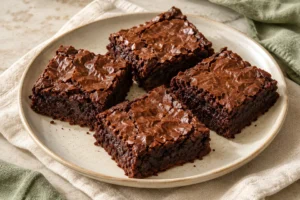
Equipment
- 20 cm square baking tin
- Mixing bowl
- Baking parchment
- Whisk
- Spatula
- Oven
- Knife
- Kitchen scale
- Measuring jug and spoons
Ingredients
- 100 g butter, melted and cooled slightly
- 180 g caster sugar
- 2 large eggs
- 1 tsp vanilla extract
- 50 g unsweetened cocoa powder
- 70 g plain wheat flour
- 0.25 tsp salt
Instructions
- Heat oven to 180°C / 350°F. Line a 20 cm square baking tin with baking paper.
- Whisk melted butter and sugar in a bowl. Whisk in eggs and vanilla until smooth.
- Sift in cocoa, flour, and salt. Fold just until no dry streaks remain; do not overmix.
- Spread batter into the tin. Bake for 22–25 minutes until the edges are set and a skewer in the center comes out with moist crumbs, not wet batter.
- Cool in the tin for at least 30 minutes before cutting into 9 squares. Do not taste raw batter.
Tips and substitutions
- Cooling time is additional to the listed prep and bake times.
- Use unsweetened cocoa rather than drinking chocolate.
- A clean skewer can mean a drier brownie; look for moist crumbs while ensuring the batter is fully baked.
- Use unsweetened cocoa powder as listed, not a drinking-chocolate mix. A sweetened mix changes both the cocoa concentration and the sugar balance. Sift out cocoa lumps so they do not remain as bitter pockets in the finished batter.
- Let melted butter cool slightly before combining it with the eggs. It should remain fluid rather than hot enough to begin cooking them. Whisk the wet mixture smooth before introducing the flour, when a gentler mixing approach becomes more useful.
- Fold just until the dry streaks disappear. Repeated beating after adding flour can make the texture tougher. Scrape the bottom of the bowl so dry flour is not left underneath an apparently smooth surface.
- The tin size affects depth and baking time. A twenty-centimeter square tin matches the stated recipe; a wider tin makes thinner brownies and a smaller tin makes deeper ones. Do not assume the same timer applies after changing the pan.
- Check the center and edges together. The edge should be set and the skewer should show moist crumbs rather than liquid batter. A completely clean skewer may mean a drier result, but visible raw batter is not the texture target.
- Cool before cutting and clean the knife between slices for neater portions. The brownie firms as it cools, so cutting immediately can make the squares collapse. Keep raw batter away from tasting or serving utensils because both flour and eggs are uncooked.
Storage and reheating
Cool before covering. Keep in an airtight container in a cool room for up to 2 days, or refrigerate for up to 4 days. Freeze cooled squares for up to 2 months for best quality.Allergens and dietary notes
Wheat · Egg · Milk Check packaged ingredients and cross-contact.Nutrition estimate per serving
One of 9 equal servings of the original recipe. Scaling the batch keeps nutrition per serving the same.
- Energy
- 215 kcal
- Protein
- 3.4 g
- Carbohydrates
- 29.3 g
- Fat
- 10.9 g
- Saturated fat
- 6.4 g
- Fiber
- 2.3 g
- Sugars
- 20.2 g
- Sodium
- 83 mg
Approximate ingredient-sum estimate, not a laboratory analysis. Brands, edible weights, substitutions and cooking losses change the result; use package labels when precise values matter.
Uses unsalted butter, granulated sugar as a proxy for caster sugar, two 50 g eggs and unsweetened cocoa. One serving is one of nine brownies.
USDA FoodData Central SR Legacy (final 2018 release; published 2019-04-01)
Ingredient matches and calculation weights
USDA nutrient values per 100 g × edible ingredient grams, summed and divided by the original base yield. US spoon/volume conversions use USDA portion weights. Water and ice are excluded from the nutrient sum. An unavailable nutrient is omitted, rather than shown as zero. All listed oils, sauces and sweeteners are counted; unlisted toppings are excluded.
- 100 g butter, melted and cooled slightly: Butter, without salt (100 g)
- 180 g caster sugar: Sugars, granulated (180 g)
- 2 large eggs: Egg, whole, raw, fresh (100 g)
- 1 tsp vanilla extract: Vanilla extract (4.2 g)
- 50 g unsweetened cocoa powder: Cocoa, dry powder, unsweetened (50 g)
- 70 g plain wheat flour: Wheat flour, white, all-purpose, enriched, unbleached (70 g)
- 0.25 tsp salt: Salt, table (1.5 g)