Lemon Herb Chicken & Potatoes
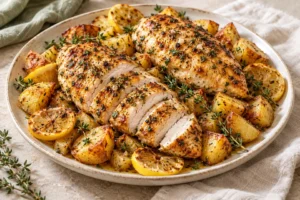
Equipment
- Large baking tray
- Food thermometer
- Knife
- Cutting board
- Mixing bowl
- Tongs
- Oven
- Kitchen scale
- Measuring jug and spoons
Ingredients
- 700 g potatoes, cut into 2 cm pieces
- 3 tbsp olive oil
- 0.75 tsp salt
- 0.5 tsp black pepper
- 600 g boneless skinless chicken breasts, 4 similar-sized pieces
- 1 lemon, half sliced and half juiced
- 3 garlic cloves, minced
- 1 tsp dried thyme
Instructions
- Heat the oven to 220°C / 425°F. Toss the potatoes with 2 tablespoons of oil, half the salt, and half the pepper on a large baking tray. Roast for 15 minutes.
- Do not wash raw chicken. In a bowl, coat the chicken with the remaining oil, salt, pepper, lemon juice, garlic, and thyme. Wash hands and surfaces after handling it.
- Turn the potatoes. Add chicken and lemon slices to the tray without crowding. Roast for 18–20 minutes more, or until the potatoes are tender and the thickest part of each breast reaches 74°C / 165°F.
- Rest the chicken for 5 minutes before slicing. Use clean utensils and serve with the potatoes.
Tips and substitutions
- Very thick breasts may need extra cooking time; temperature decides doneness.
- Cut potatoes evenly so they finish together.
- Keep raw poultry and its utensils away from ready-to-eat food.
- The potato head start is part of the method, not an optional delay. Dense potato pieces need longer than the chicken in this recipe. Keep their size close to two centimeters so the stated sequence remains a useful guide.
- Choose chicken pieces of reasonably similar thickness. Equal weight does not guarantee equal thickness, and a thick center can take longer to finish. Check the thickest point of each piece rather than using the smallest breast as the guide for the tray.
- Keep room around the chicken and potatoes. If the tray is packed tightly, moisture accumulates and the potato edges may remain pale. Use a second tray when necessary instead of stacking ingredients, and monitor both trays for uneven oven heat.
- The lemon is divided between juice and slices for different jobs. Juice coats the chicken with the seasonings; slices roast beside it. Keep the garlic distributed in the coating rather than leaving a thick mound on top of one breast.
- Use the rest time after the chicken reaches the instructed temperature. Move it with clean utensils, then let it stand before slicing. If the potatoes still need a few minutes, they can remain in the oven while the chicken rests separately.
- Prepare a clean serving plate and any ready-to-eat accompaniment before the raw-chicken stage. Do not reuse the coating bowl for the finished meal. Portion leftovers according to the storage guidance rather than leaving the entire tray on the counter after serving.
Storage and reheating
Refrigerate in a shallow, covered container within 2 hours (within 1 hour above 32°C / 90°F). Keep at 4°C / 40°F or below and use within 3 days. Reheat cooked leftovers to 74°C / 165°F, adding a splash of water if needed.Allergens and dietary notes
No major allergens in the listed ingredients; check packaged products Check packaged ingredients and cross-contact.Nutrition estimate per serving
One of 4 equal servings of the original recipe. Scaling the batch keeps nutrition per serving the same.
- Energy
- 412 kcal
- Protein
- 37.6 g
- Carbohydrates
- 32.8 g
- Fat
- 14.3 g
- Saturated fat
- 2.3 g
- Fiber
- 4.1 g
- Sugars
- 1.8 g
- Sodium
- 515 mg
Approximate ingredient-sum estimate, not a laboratory analysis. Brands, edible weights, substitutions and cooking losses change the result; use package labels when precise values matter.
Uses raw skinless chicken breast, 29 g edible lemon slices plus 24 g lemon juice. Includes all listed oil and lemon; discarded juices or slices lower the amount eaten.
USDA FoodData Central SR Legacy (final 2018 release; published 2019-04-01)
Ingredient matches and calculation weights
USDA nutrient values per 100 g × edible ingredient grams, summed and divided by the original base yield. US spoon/volume conversions use USDA portion weights. Water and ice are excluded from the nutrient sum. An unavailable nutrient is omitted, rather than shown as zero. All listed oils, sauces and sweeteners are counted; unlisted toppings are excluded.
- 700 g potatoes, cut into 2 cm pieces: Potatoes, flesh and skin, raw (700 g)
- 3 tbsp olive oil: Oil, olive, salad or cooking (40.5 g)
- 0.75 tsp salt: Salt, table (4.5 g)
- 0.5 tsp black pepper: Spices, pepper, black (1.2 g)
- 600 g boneless skinless chicken breasts, 4 similar-sized pieces: Chicken, broiler or fryers, breast, skinless, boneless, meat only, raw (600 g)
- 1 lemon, half sliced and half juiced: Lemons, raw, without peel (29 g); Lemon juice, raw (24 g)
- 3 garlic cloves, minced: Garlic, raw (9 g)
- 1 tsp dried thyme: Spices, thyme, dried (1 g)